
Technical Notes
Fundamentals of Vibration Control
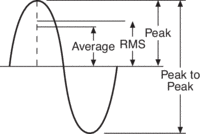
This technical note describes the fundamentals of vibration and how these concepts relate to measurable parameters such as compliance and maximum relative motion.
Technical Notes
Vibration Control Unit Conversion Charts and Constants
This technical note details acceleration, displacement, frequency, compliance, pressure, and temperature along with conversion charts.
Technical Notes
Optical Table System Design
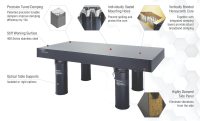
The term optical table system typically refers to a vibration-isolation system, that is, the tabletop plus the support system.
Technical Notes
Designing with VIB320 Vibration Isolation Bearings
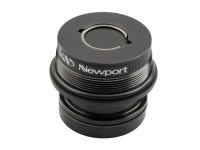
Newport's VIB320 Series isolators utilize patented VIBe™ technology to attenuate the transmission of vibrations without the need for electronics, air hoses, compressor or other supporting hardware. They offer robustness for tough environments, quicker settling time than pneumatic isolators and maintenance-free operation.
Tutorials
Approximating Real-World Beam Deflection
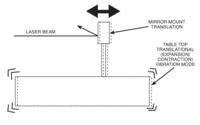
Newport’s Maximum Relative Motion formula provides an excellent approximation of maximum (worst-case) table top deflection. This technical note explains and quantifies the relationship between Maximum Relative Motion and actual beam deflection in real-world applications.
Selection Guides
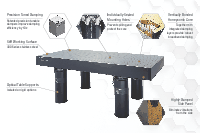
Optical Table Selection Guide
Newport offers a wide variety of Optical Tables including our broadband damped RPR Series Optical Tables, precision tuned damped RS Series Optical Tables, and actively damped SmartTable Optical Tables with IQ Damping Technology. Our optical table solutions are designed to fit any performance, budget and delivery need.
Tutorials
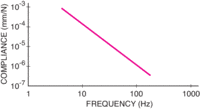
How to Approximate an Optical Tables Ideal Rigid Body Line
The compliance of a body is defined as the displacement amplitude of a point on the table surface per unit of force applied. Under the influence of a time-varying force, the compliance of a free ideal rigid body in one dimension is proportional to the inverse square of the frequency.
Tutorials
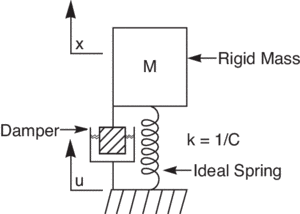
About Optical Table Performance Specifications
The dynamic rigidity of a table top (its resistance of the top surface movement from vibration) is the single most important measure of vibration control performance. But compliance curves, the classic method of measuring dynamic rigidity, do not go far enough in providing a quantitative measure of table top vibration control capabilities.