
Types of Photoreceivers
High-Speed
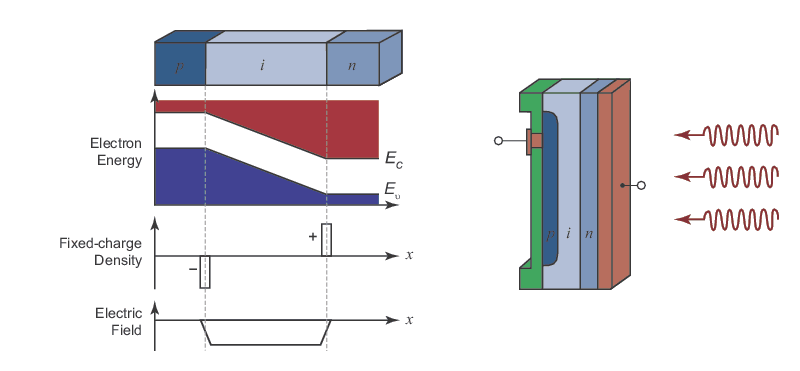
Based on the discussion above, diffusion of carriers to the depletion region is a relatively slow process in reverse biased p-n junctions that could serve to limit the response time of a photoreceiver. To minimize this effect, a p-i-n photodiode is typically utilized where an un-doped intrinsic layer is sandwiched between the p and n layers in a p-n junction (see Figure 1). This structure effectively widens the depletion layer. This results in a greater proportion of the generated current being carried by the faster drift process instead of diffusion. The increased depletion width also allows for a reduction in the RC time constant (via a decreased junction capacitance) and increased area for capturing light. The p-i-n device structure is ubiquitous in high-speed photoreceivers and enables fast rise times and large bandwidths. However, the final measured optical signal will be as slow as the slowest component of a detection system even if a sufficiently fast photoreceiver is employed. Therefore, care should be taken when choosing connectors, cables, an oscilloscope, and a spectrum analyzer to measure a fast optical signal.
Balanced Detection
Low-Light

For additional insights into photonics topics like this, download our free MKS Instruments Handbook: Principles & Applications in Photonics Technologies
Request a Handbook