Technical Notes
Essentials of Laser Safety
Learn about laser classifications and the controls and protective equipment required to stay safe.
Technical Notes
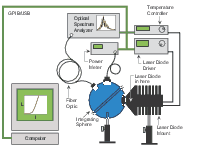
Fundamentals of Laser Diode Control
To assess the quality, performance, and characteristics of laser diodes, manufacturers often perform exhaustive testing which requires electro-optical, spectral and spatial characterization of the laser output.
Technical Notes
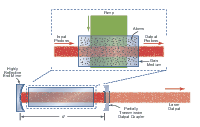
Laser Physics
A laser is a source of coherent light. It contains an optical oscillator that increases the amplitude of an optical field while maintaining its phase. This coherent amplification is achieved through Light Amplification by Stimulated Emission of Radiation (LASER).
Technical Notes
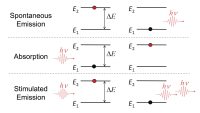
Light-Matter Interactions in Lasers
Light is generated from a laser as a result of the following process: electrons in a material move from an excited energy level to a lower-lying energy level and produce photons that contribute to the laser beam.
Technical Notes
Characteristics of Laser Light
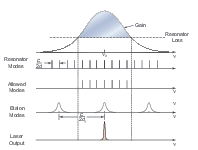
The most common laser light characteristics include: wavelength, gain bandwidth, monochromaticity, spatial and temporal profiles, collimation, output power, coherence and polarization.
Technical Notes
Critical Laser Components
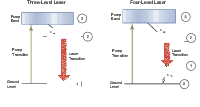
The critical components of a laser are a gain medium (acts as medium for population inversion), a pump source (serves as energy source for inverting population), and a resonator (provides feedback).
Technical Notes
Types of Lasers
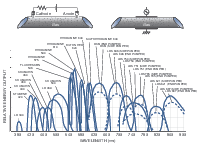
Lasers are typically identified by their gain medium and are often classified by the radiating species that give rise to stimulated emission. These radiating species can include atoms and molecules in a dilute gas, organic molecules dissolved at relatively low concentration in liquid solutions, semiconductor materials, and dielectrics such as crystalline solids or glasses that are doped with a high concentration of ions.
Technical Notes
Methods for Pulsed-Laser Operation
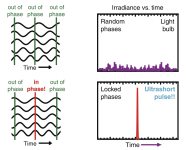
It is often desirable to operate lasers in a pulsed mode since this can significantly increase the peak output power.
Technical Notes
Laser Spectral Tunability
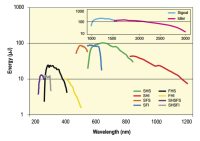
The first way to perform laser wavelength tuning uses a wavelength-selective element to choose a specific portion under a gain bandwidth to lase. The second method of wavelength tuning involves nonlinear frequency conversion.
Technical Notes
Laser Diode and LED Physics
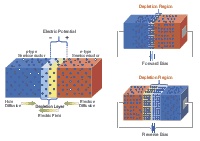
Laser diodes possess several unique attributes compared to other types of lasers. They are very small compared to other classes of lasers, can operate very efficiently with relatively low input powers, and are compatible with modern electronics.
Technical Notes
Optical Emission in Semiconductor Materials
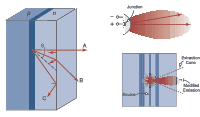
Electron-hole recombination processes give rise to spontaneous emission in an LED and stimulated emission in a laser diode.
Technical Notes
Laser Diode and LED Light Characteristics
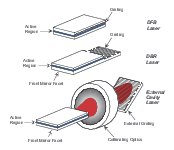
Semiconductor lasers offer the benefits of efficiency, electrical pumping, and the ability to easily integrate with modern electronics which contribute to their ubiquitous usage.
Technical Notes
Laser Diode Production Burn-In
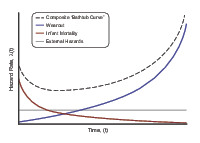
High temperature burn-in screening is used in laser diode manufacturing to screen out devices that are likely to have unacceptably short lives and to ensure that the remaining population of lasers will have a statistically acceptable level of reliability.
Technical Notes
Laser Diode Life Testing
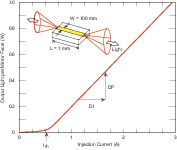
Life test studies are used to collect laser diode lifetime data under carefully controlled operating conditions. These data are then used to develop statistical models that can predict the laser lifetime under the intended operating conditions.
Technical Notes
Laser Diode Characterization
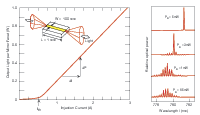
Laser diodes are characterized by their inherent physical properties within five distinct categories, including: electrical, spatial, spectral, optical, and dynamic properties.
Technical Notes
Solar Light Simulation
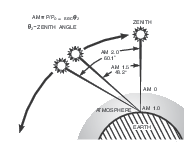
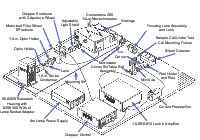
The surface temperature of the sun is approximately 5800 K; this means that the electromagnetic spectrum of radiation from the sun is similar to that of a 5800 K blackbody with the exception that it includes fine structure due to absorptions by cool gases in the solar periphery.
Technical Notes
Tunable Incoherent Light Sources
The TLS is versatile, being both a broadband and high-resolution monochromatic light source which makes it suitable for applications such as the study of wavelength-dependent chemical or biological properties and wavelength-induced physical changes in materials.
Technical Notes
Tunable Light Sources: A Popular Choice for Measurement Applications
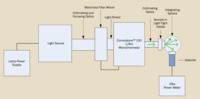
Many common spectroscopic measurements require the coordinated operation of a detection instrument and light source, as well as data acquisition and processing. Integration of individual components can be challenging and various applications may have different requirements. Conventional lamp- based tunable light sources are a popular choice for applications requiring a measurement system with this degree of capability.
Technical Notes
Gaussian Beam Optics
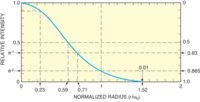
The Gaussian has no obvious boundaries to give it a characteristic dimension like the diameter of the circular aperture, so the definition of the size of a Gaussian is somewhat arbitrary. Figure 1 shows the Gaussian intensity distribution of a typical HeNe laser.
Tutorials
Light Collection and Systems Throughput
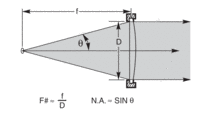
This discussion is restricted to the general use of Incoherent Light Sources, such as arc lamp or quartz tungsten halogen sources. Diffraction and coherent effects are excluded. The emphasis throughout this section will be on the collection of light.
Page 1 of 18