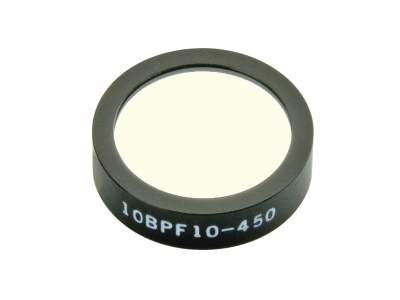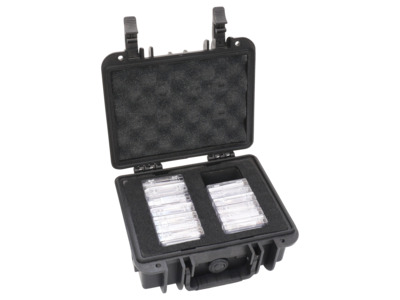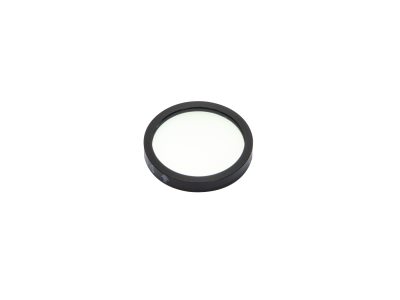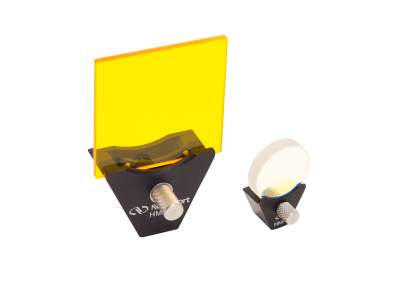
Clearance Laser Line Bandpass Filters
Clearance Laser Line Bandpass Filters
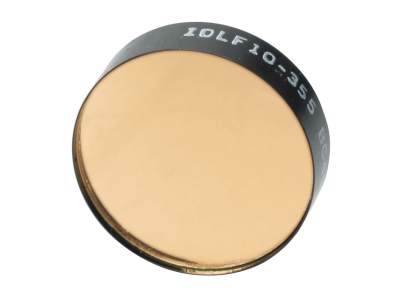
Laser line filters are ideal for transmitting laser light while suppressing ambient light. The center wavelength shifts linearly with temperature less than 0.02 nm/°C. The highly reflective side of the filter should generally face the source, minimizing the thermal load on the blocking glass and epoxies. These filters are on clearance and only available for a limited time while supplies last.
- Out-of-band blocking to less than 0.01% (10-4)
- Excellent temperature stability
- Center wavelengths at common laser lines
- 12.7 and 25.4 mm diameters See All Features
Features
Excellent Out-of-Band Blocking
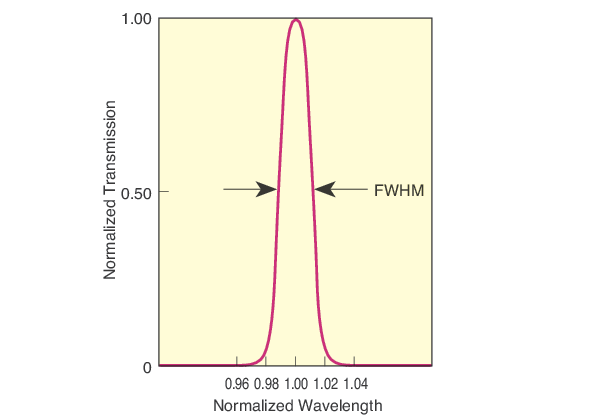
Our laser line bandpass filters cover most of the common laser lines and feature excellent out-of-band blocking of less than 0.01% (10-4). The highly reflective side of the filter should generally face the source, minimizing the thermal load on the blocking glass and epoxies.
Center Wavelengths for Common Lasers
Sensitivity to Angle of Incidence
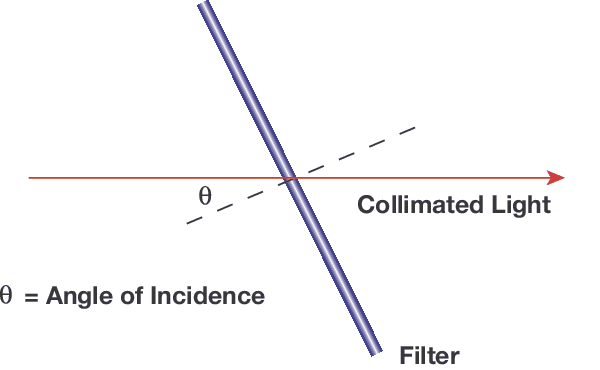
An increase in the angle of incidence causes a shift of the center wavelength to shorter wavelengths. This can be very useful in tuning a narrowband filter to a desired wavelength. The wavelength shift with angle of incidence, can be calculated by: λθ= λo [1-(no/ne)2 sin2θ]1/2 where λθ is the wavelength at the new angle of incidence; λo is the center wavelength; no is the index of refraction of the environment (no = 1 in air); ne is the effective index of refraction of the filter; and θ is the angle of incidence.
Excellent Temperature Stability
The center wavelength shifts linearly with temperature less than 0.02 nm/°C. The wavelength shifts in the direction of the temperature change. In use, the highly reflective side of the filter should generally face the source, minimizing the thermal load on the blocking glass and epoxies.