Sorry, this family of products is no longer available.
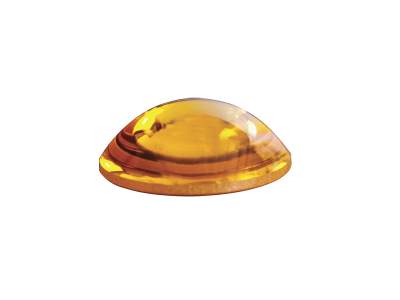
Zinc Selenide Infrared Aspheric Lenses
Zinc Selenide Infrared Aspheric Lenses
Zinc Selenide aspheric lenses provide diffraction limited performance are an excellent choice for a variety of IR applications including infrared sensing and spectroscopy, femtosecond lasers systems, high power CO2 laser systems.
- Very low GVD in Mid-IR region
- Reduced spherical aberrations
- 800 nm to 16 µm wavelength range
- Computer optimized to provide diffraction limited performance
- Useful for femtosecond pulse applications
- Usable in CO2 laser focusing applications See All Features
Features
Advantage of Aspheric Lenses
In applications that require large acceptance angles, such as light gathering for illumination, spherical lenses are unsuitable due to spherical aberration, or the effect of refractive power of a spherical surface becoming greater with increasing aperture. Aspheric lenses maintain constant focal length or very high NA, avoiding the need for multiple elements to correct spherical aberration. This simplifies system design by reducing weight and component count. It also results in less transmission loss, and less ghosting due to having fewer surfaces. The primary drawback of aspheric lenses is off-axis performance is poor. This is not a problem for coupling to and from optical fibers or collimating light sources, but aspheric lenses are not usable over a wide field of view.
Great for CO2 Laser Focusing Applications
Zinc Selenide offers low IR absorption, and high resistance to thermal shock. The uncoated ZnSe aspheric lenses (ZNPA series) provide diffraction limited focusing performance, ideal for focusing the output of a CO2 laser.