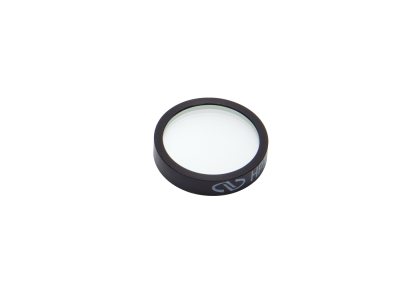
Fluorescence Emission Bandpass Filters
Fluorescence Emission Bandpass Filters
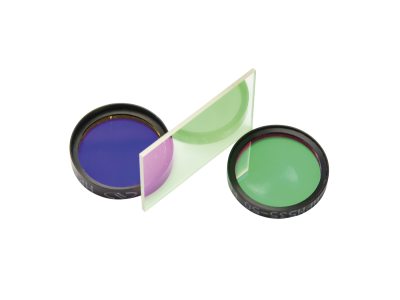
Our high performance fluorescence (HPF™) bandpass filters for fluorescence microscopy have been manufactured to provide maximum performance using several key design features including exceptionally high passband transmission, maximized out-of-band blocking including extended range blocking on excitation filters, extremely steep slopes from rejection to transmission regions, high-precision optical glass substrates, and spectral specifications providing maximum image brightness and minimum background.
- Patented Stabilife® hard coatings
- Lowest autofluorescence
- Extremely sharp transitions from rejection to transmission regions
- Maximum transmission
- Optimized optical fabrication for brilliant imaging See All Features
| Compare | Description | Drawings, CAD & Specs | Avail. | Price | ||
|---|---|---|---|---|---|---|
 | HPM460-60Bandpass Filter, Fluorescence, 25.0 mm, 460 nm Center, 60 nm Bandwidth | 4 Weeks | ||||
| HPM470-30Bandpass Filter, Fluorescence, 25.0 mm, 470 nm Center, 30 nm Bandwidth | 4 Weeks | ||||
| HPM480-40Bandpass Filter, Fluorescence, 25.0 mm, 480 nm Center, 40 nm Bandwidth | In Stock | ||||
| HPM510-50Bandpass Filter, Fluorescence, 25.0 mm, 510 nm Center, 50 nm Bandwidth | In Stock | ||||
| HPM530-LPLongpass Filter, Fluorescence, 25.0 mm, 535 nm Cut-On, 540-750 nm Transmission | In Stock | ||||
| HPM535-30Bandpass Filter, Fluorescence, 25.0 mm, 535 nm Center, 30 nm Bandwidth | In Stock | ||||
| HPM535-50Bandpass Filter, Fluorescence, 25.0 mm, 535 nm Center, 50 nm Bandwidth | 4 Weeks FREE 2-day shipping on thousands of products on Newport.com Learn More | ||||
| HPM540-40Bandpass Filter, Fluorescence, 25.0 mm, 540 nm Center, 40 nm Bandwidth | In Stock | ||||
| HPM545-30Bandpass Filter, Fluorescence, 25.0 mm, 545 nm Center, 30 nm Bandwidth | In Stock | ||||
| HPM550-40Bandpass Filter, Fluorescence, 25.0 mm, 550 nm Center, 40 nm Bandwidth | In Stock |

Specifications
- SizeØ25.0 mm
- Thickness4.3 mm
- Surface QualityE/E (60/40) per MIL-F-48616 (typical)
- Transmission≥90%
- Humidity ResistanceMIL-STD-810, Method 507.3, Procedure III, Modified to 40 cycles
- Blocking≥OD6
- Abrasion, Adhesion, HardnessMIL-C-48497
- Temperature Range-100 °C to 300 °C
Features
Superior Stabilife® Coating Technology
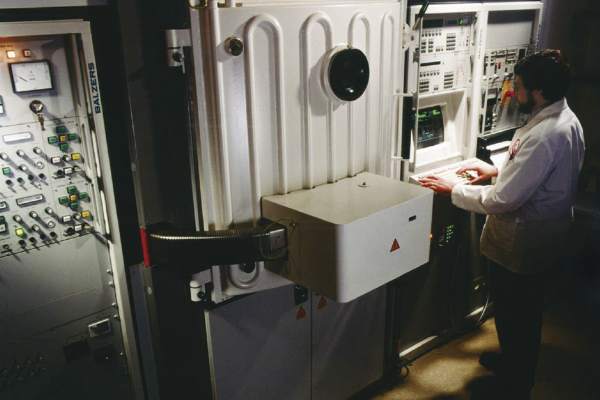
HPF™ fluorescence filters are manufactured using our patented Stabilife® coating technology. They are manufactured using two patented processes for the deposition of metal oxide thin film optical coatings: Reactive Ion Plating (RIP) and Hybrid Plasma Enhanced Deposition (HPED). Both processes yield highly dense, thin film coatings with extraordinary hardness, abrasion resistance, and adhesion to the substrate. Newport's Stabilife processes have been in full-scale production at our coating facility in Franklin, Massachusetts since the early 1990s.
Higher Film Density & Maximized Spectral Stability
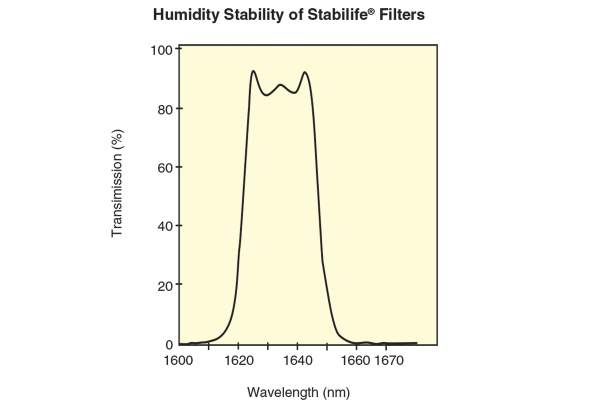
For demanding applications such as fluorescence detection, wavelength stability is absolutely critical to insure dependable results. Newport's fluorescence filters with Stabilife coating technology have much higher spectral stability than competitors. One of the critical factor affecting the spectral stability of an optical coating is film density. Unlike competitor's unstabilized metal oxide thick film coating with less film density which typically contributes to environmentally induced spectral shift of 2-5%, Newport's Stabilife coatings have a much higher density and lower void ratio and are therefore less affected by water absorption. They typically exhibit total wet-to-dry shifts of less than 0.02% of wavelength.
Minimized Spectral Shifting for Temperature Variations
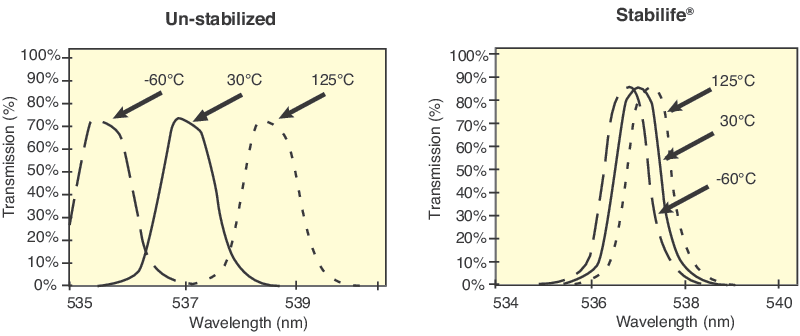
Stabilife coatings are typically 5 to 10 times less sensitive to thermal variation than un-stabilized metal oxide films as a result of film densification. Temperature change functions are a catalyst for moisture migration in thin films having a significant volume of voids. When un-stabilized films are exposed to high temperatures, moisture migrates out of film voids contributing to the wavelength change discussed earlier. The high film density and reduced permeability resulting from the Stabilife processes reduces this effect providing the maximum spectral stability available for all types of precision coatings including bandpass, dichroic, edge, notch and polarizer coatings.
Resources
Literature
Fluorescence Filters Brochure(2.1 MB, PDF) Flow Cytometry Brochure(7.1 MB, PDF)