Application Notes
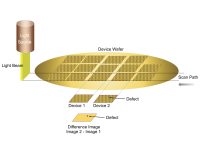
Semiconductor Inspection
In this application note, we provide a brief description of the basics of wafer and reticle inspection techniques and discuss the characteristics of current inspection tools.
Application Notes
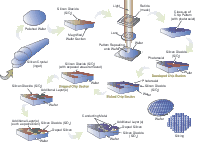
Semiconductor Manufacturing Overview
This application note provides a brief overview of semiconductor manufacturing and describe the various optical techniques used to define, inspect, and measure feature sizes and layer properties throughout the manufacturing process.

Application Notes
Differences Between Threshold Current Calculations
This application note explains the four Telcorida recognized threshold calculation methods, and why each method will result in a slightly different threshold value.
Application Notes
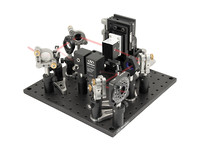
Burst Picker for CW Mode-Locked Lasers
In this Application Note we describe Newport Corporation’s new Burst Picker. When used in conjunction with a CW mode-locked laser such as Spectra-Physics® Mai Tai® DeepSee, the Burst Picker excites samples via a “burst” mode.
Application Notes
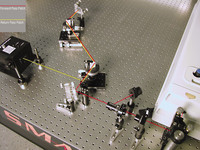
Prism Compressor for Ultrashort Laser Pulses
This application note demonstrates a simple and cost effective prism compressor for ultrashort laser pulses. The purpose of this compressor is to provide means of controlling dispersion of the femtosecond pulses on a typical experimental set-up that includes oscillators, amplifiers and OPAs.
Application Notes
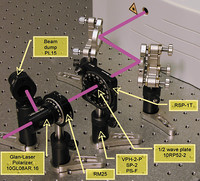
Variable Attenuator for Lasers
This application note details a simple and cost effective solution for the continuous attenuation of laser output power. The attenuator kit described is based on a half waveplate and polarizer. It is suitable for 690-1040 nm linearly polarized laser beams with average power up to 100 watts.
Application Notes
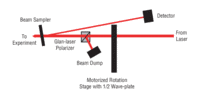
Computer Controlled Variable Attenuator for Tunable Lasers
This application note describes a closed loop, computer controlled, variable attenuator for the control of output power from a tunable laser. It is based on the combination of a 1/2 wave-plate and a polarizer. The algorithm used to control power operates in a closed loop with PID feedback, compensating for slow changes in output power.
Application Notes
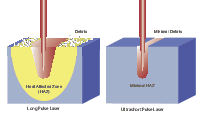
Laser Micromachining
Laser machining is a non-contact process that can achieve higher precision and quality, smaller features, improved consistency with no tool wear, and possesses the flexibility to machine different materials.
Application Notes
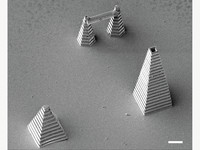
Workstation for Laser Direct-Write Processing
Lasers exhibit a number of features that makes them unique sources of energy for several material processing methods. For example, they are indispensable tools for drilling, welding, and cutting in industrial manufacturing where high average and peak powers are required.
Application Notes
Synchronization of Two Spitfire Pro Amplifiers
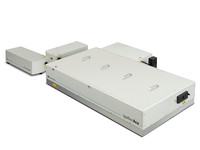
The invention of nanosecond pulsed lasers utilizing the Q-switch principle marked the advent of time-resolved spectroscopy. Over the past four decades, the pulse duration has been reduced from nanosecond to attosecond regimes thanks to breakthroughs in technology and physics.
Application Notes
Coherent Anti-Stokes Raman Scattering
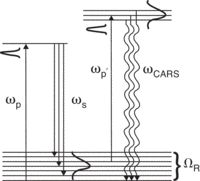
Coherent Anti-Stokes Raman Scattering (CARS) was first reported in 1965 by Maker and Terhune as a method of spectroscopy for chemical analysis. CARS involve the interaction of four waves designated as pump (p), Stokes (s), probe (p’) and anti-Stokes (CARS) where pump and probe are usually fixed to the same frequency.
Application Notes
Photoresponse Mapping of Photovoltaic Cells
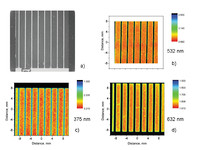
The performance of a photovoltaic (PV) cell can be quantified by measuring its spectral response and I-V curve. From these measurements the parameters like external quantum efficiency (EQE%), fill factor, efficiency, and maximum power can be derived.

Application Notes
Two-Photon Excited Fluorescence Microscopy
Several laser-scanning microscopy techniques have been developed in the last twenty years based on non-linear optical phenomena. This has led to a variety of powerful imaging tools, such as two-photon excited fluorescence microscopy.
Application Notes
The Spectral Mismatch Factor
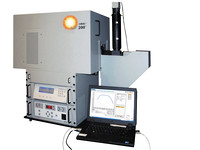
A reference solar cell is calibrated when its short-circuit current is known with respect to an internationally accepted set of test conditions called the Standard Test Conditions (1 Sun or 1000 W/m2 of AM1.5G and a cell temperature of 25°C).
Application Notes
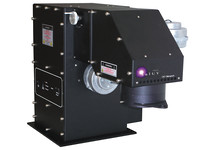
Photo Biological Testing with With UV Solar Simulators
Photo-biology is the study of the effect of UVA and/or UVB, visible, and IR radiation upon living systems. The first law of photochemistry (Grotthaus-Draper Law) states that light must be absorbed for a photochemical event to occur.
Application Notes
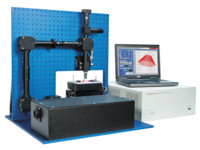
Ultrafast Laser Micromachining with Newport XYZ Motion System
With rapid advancements in ultrafast laser technology in recent years, optical waveguide writing in bulk glass using femtosecond pulsed lasers has emerged as a powerful micro-fabrication technique in both scientific and industrial markets.
Application Notes
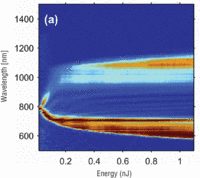
Supercontinuum Generation in SCG-800
As a PCF based supercontinuum source, Newport offers the SCG-800. It is a pre-assembled device consisting of a polarization maintaining PCF designed for zero dispersion at 750 nm in a hermetically sealed one inch diameter package.
Application Notes
High Performance Temperature Control in Laser Diode Test Applications
A typical application in laser diode test is the characterization of laser output over wide temperature ranges, typically from 0°C to 85°C. Quick changes to and rapid stabilization of laser diode case temperature implies increased production throughput due to quicker laser characterizations.
Application Notes
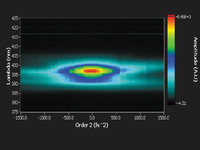
Automated Control of Amplified Pulse Duration
Pulse shaping systems are now widely used by the ultrafast laser community for applications ranging from coherent control to multi-photon microscopy. Of particular interest is the ability to directly drive the pulse shaper using the output signal of an experiment.
Technical Notes
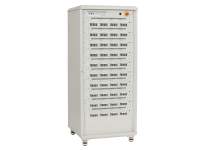
LRS-9434 Temperature Set Point Accuracy
The LRS-9434 Test System utilizes a family of fixtures that are designed to ensure set point accuracy of +/- 2.0 C across a range of 40 to 150 C.
Page 1 of 3