Resources & Downloads
Application Notes
Hexapod with Image Derotator Brings Innovative Metrology Tools to Industrial Manufacturing(530.2 kB, PDF) Space Optics and Metrology with Hexapods(431 kB, PDF) Hexapod Solutions for Mass Transfer & Die Repair in Micro LED Manufacturing Equipment(2.1 MB, PDF) Precision Alignment in Photonic Device Assembly and Testing(2.6 MB, PDF)
Technical Notes
Motion in 3-D: Newport Hexapod Coordinate Systems(476.8 kB, PDF) Maintaining HXP Position after Controller Reboot(67.3 kB, PDF) GroupPositionCurrentGet command and HXP controller.pdf(915.7 kB, PDF)
Literature
HexaViz Hexapod Brochure(2.5 MB, PDF) HXP Series Hexapod Brochure(2.3 MB, PDF)
Manuals
XPS-D Configuration Manual.pdf(5.6 MB, PDF) HXP50-MECA User Manual(5.1 MB, PDF) HXP100-MECA User Manual(5.8 MB, PDF) HXP100P-MECA User Manual(10.5 MB, PDF) XPS Unified - Programmer's Manual.pdf(6.8 MB, PDF)
Related Products
Q: How do you move a sample relative to a tool or vice versa in a Hexapod?
A: The incremental moves in the Hexapod enable easy, intuitive motions without complex mathematics or manual coordinate transformations by users. For instance, an incremental move in the Work coordinate system allows users to move and align a sample position to a laser beam or a tool. Once the move is completed, an incremental move in the Tool coordinate system brings every reachable point of the sample into the laser beam or the tool.
Q: How is the ‘Incremental Move in Tool’ really different than the ‘Incremental Move in Work’?
A: An incremental move in the Tool coordinate system is made along the axes of the Tool coordinate system (moving with the carriage) and the center of rotation is at an interim origin of the Tool coordinate system. This means that, when the carriage moves in XYZ, the center of rotation in Tool also moves to the new center location of the carriage. On the other hand, an incremental move along the Work coordinate system uses the fixed work coordinate system as reference. So, the center of rotation in Work does not change when the carriage moves in XYZ.
Q: How are Hexapod coordinate transformations handled with virtual pivots?
A: Coordinate transformations for a moving Stewart Platform with six-degrees of freedom relative to a virtual pivot are not only important for many applications, but also complex and can require a great deal of computation. Initial Hexapod move to an application specific point of interest is often straightforward. However, sequential moves can grow increasingly complex as orientation changes and coordinates must be transformed to achieve target positions relative to current Hexapod position. With this in mind, Newport has developed an innovative approach to multiple coordinate systems that provide a fixed reference and a transformed reference. The Work coordinate system provides a fixed reference in space and the Tool Coordinate System provides a transformed reference based on current Hexapod top plate position with a defined offset. This approach allows the user the option to move in the original coordinate system or in the transformed coordinate system, defined by Tool. This innovative approach enables the Hexapod user to move to an application specific point of interest with the best position/orientation and then make sequential moves from this position/orientation without the need for assigning moves via transformed coordinates. Simply assign moves in the Tool Coordinate System to make incremental moves, since this transformation has been done for the user. This automatic coordinate system transformation is based on an internal algorithm running on the powerful HXP-ELEC controller and makes the Newport Hexapod very efficient and user-friendly for application specific deployment and is ideal for coupled Hexapod end effector to external device.
Hexapod Motion Controllers
| Compare | Description | Drawings, CAD & Specs | Avail. | Price | ||
|---|---|---|---|---|---|---|
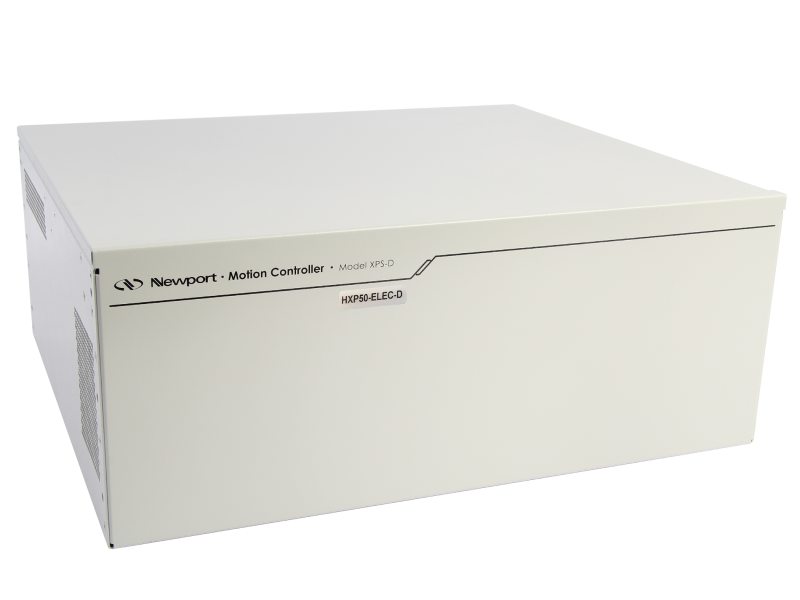 | HXP50-ELEC-DMotion Controller, Hexapod, HXP50-MECA | |||||
| HXP100-ELEC-DMotion Controller, Hexapod, HXP100-MECA | |||||
| HXP100P-ELEC-DMotion Controller, Hexapod, HXP100P-MECA |