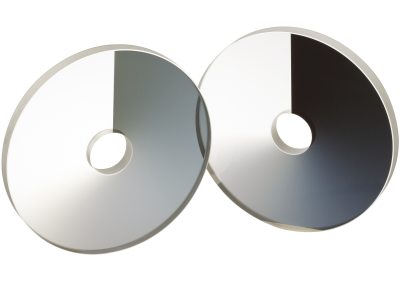
Circular Variable Metallic Neutral Density Filters
Circular Variable Metallic Neutral Density Filters
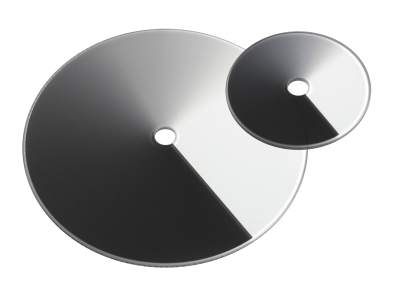
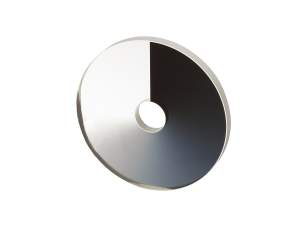
The circular variable ND filters allow users to finely tune the power of a transmitted beam, or to split a beam with an arbitrary power ratio easily by simply rotating the filter.
- Filter OD varies continuously with rotation angle
- Dual purposed as variable beamsplitter
- AR coated second surface
- ≤1λ and 30-10 scratch-dig See All Features
| Compare | Description | Drawings, CAD & Specs | Avail. | Price | ||
|---|---|---|---|---|---|---|
 | 50Q04AV.2 | FREE 2-day shipping on thousands of products on Newport.com Learn More |

Specifications
- SizeØ127.0 mm
- Optical Density Tolerance±0.15 over 270° at 0° AOI
- Damage Threshold75 W/cm2 CW, 10 mJ/cm2 with 10 nsec pulses at the specified wavelength, typical
- Size Tolerance+0/-0.25 mm
- Thickness9.53 mm
- Thickness Tolerance±0.38 mm
- Surface Quality30-10 scratch-dig
- Clear ApertureFrom 33 mm to 101 mm diameter
- Chamfers0.50–1.52 mm face width
- Chamfers Angle Tolerance45° ±15°
- DurabilityMetalized area MIL-M-13508C, AR coated area MIL-C-675, moderate abrasion
- Inside Diameter25.4 mm
Features
Finely Control Beam Attenuation
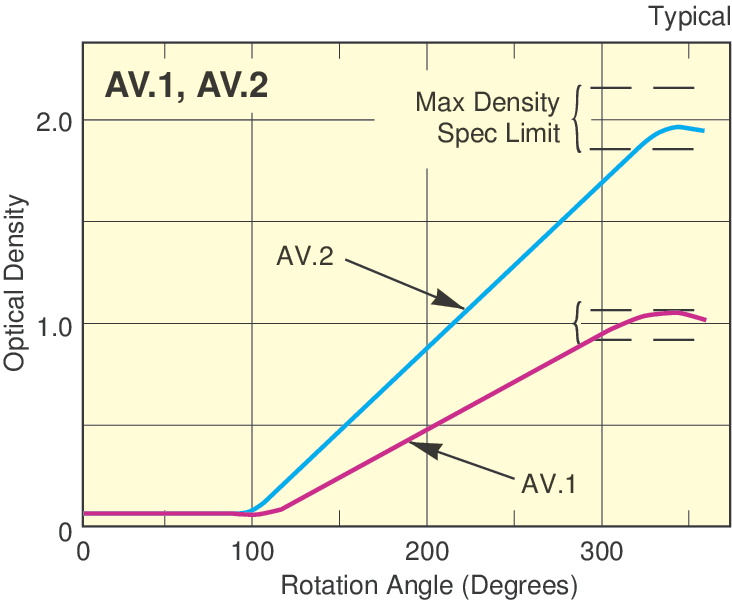
These filters allow convenient adjustment of beam attenuation by simply rotating the filter. Optical density varies continuously from 0.05–1.0 (or 0.05-2.0) across a 270° angular range. The thin reflective aluminum film is able to withstand moderate power laser beams.
Optimized for 450-700 nm Wavelength Range
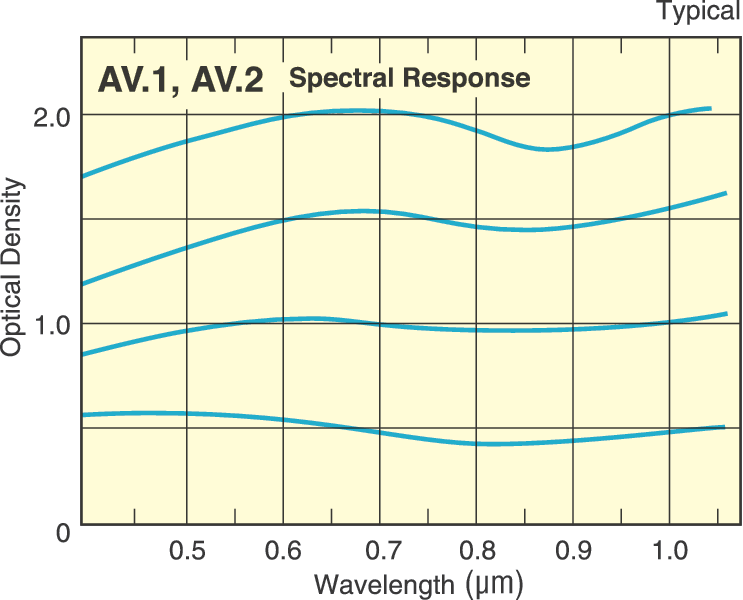
Circular variable ND filter coating are optimized for 450–700 nm, they will operate from 400–1100 nm with only minor losses.
Proper Orientation
To prevent unwanted interference from etalon effects, filters should be angled slightly with respect to the incident beam. To minimize back reflections, the filter should be oriented with the coated metallic surface facing the incident beam. Any light reflected from the uncoated second surface will pass through the metallic coating first, which will greatly attenuate unwanted back reflections.
AR Coated Second Surface
The second surface of this circular linear variable filter is AR coated to prevent undesired transmission loss, and to reduce stray light due to back reflections. The AR coating is optimized for 440 to 700 nm.
Circular ND Filter Mounting
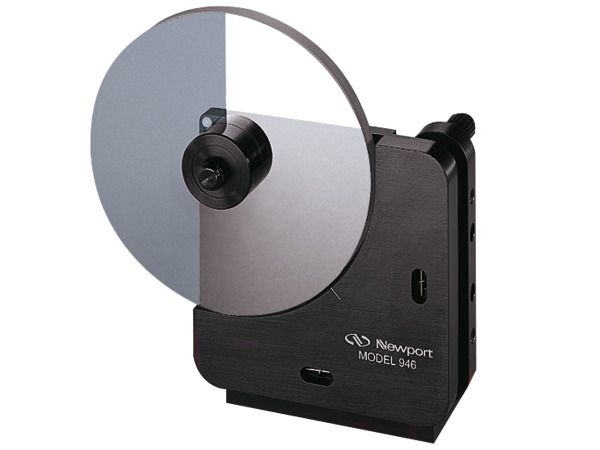
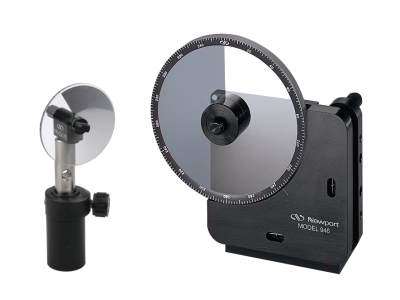
Our circular variable attenuators are ideally mounted with our
Variable Beamsplitter Applications
These filters consist of a thin metallic coating of variable thickness. Because attenuation is primarily caused by reflection with only a small amount of absorption, these filters may optionally be used as variable beamsplitters.