Sorry, this family of products is no longer available.
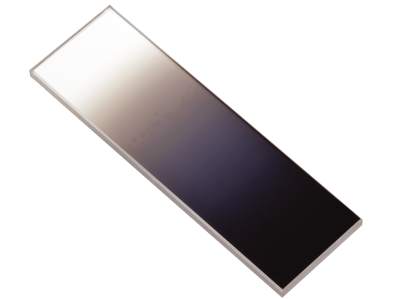
Linear Variable Metallic Neutral Density Filters
Linear Variable Metallic Neutral Density Filters
These ND filters provide linearly varying attenuation or beamsplitting in the visible and NIR region. Attenuation is achieved by a thin film of aluminum protected with an overcoat, and variable beamsplitting is an added benefit of the inherent reflectivity of aluminum. The BK 7 or UV fused silica substrates have a slight wedge between the faces to eliminate unwanted fringe patterns and cavity feedback, and the rear surface is also antireflection coated for the broadband visible range.
- Filter OD varies linearly with position
- Dual purpose as variable beamsplitter
- Broadband for Visible to NIR
- Matched pairs enable larger uniform apertures
- Broadband AR coated second surface See All Features
Features
Finely Control Beam Attenuation
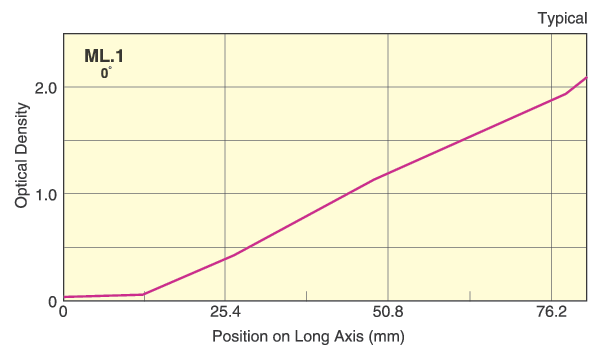
These filters allow convenient adjustment of beam attenuation by translating the filter using a linear stage. Optical density varies linearly with position from OD 0.08-2.

Slight Wedge
To prevent unwanted interference from etalon effects, these filters have a 15 arc min wedge. To minimize back reflections, the filter should be oriented with the coated metallic surface facing the incident beam. Any light reflected from the uncoated second surface will pass through the metallic coating first, which will greatly attenuate unwanted back reflections.
Variable Beamsplitter Applications
These filters consist of a thin metallic coating of variable thickness. Because attenuation is primarily caused by reflection with only a small amount of absorption, these filters may optionally be used as variable beamsplitters. Variable beamsplitters are useful for applications such as holographic nondestructive examination (NDE). In holographic NDE, a beam from a laser is split into two beams. One beam is expanded using a spatial filter to create a uniform reference beam. The other is used to illuminate the object being tested. A signal beam is formed from the light reflected from or transmitted through this object. The two beams may then be recombined to form detectable interference fringes. Intensity of the signal will vary greatly as a function the reflectance (or transmittance) of the specimen. This can be compensated using a variable beam split ratio.
Matched Filter Pairs
Two filters can be used such that when stacked, the gradient of the metallic coatings will create an more even distribution. When you have a larger beam diameter, it is typically preferable to have the beam evenly attenuated.